
What is dial-up internet?
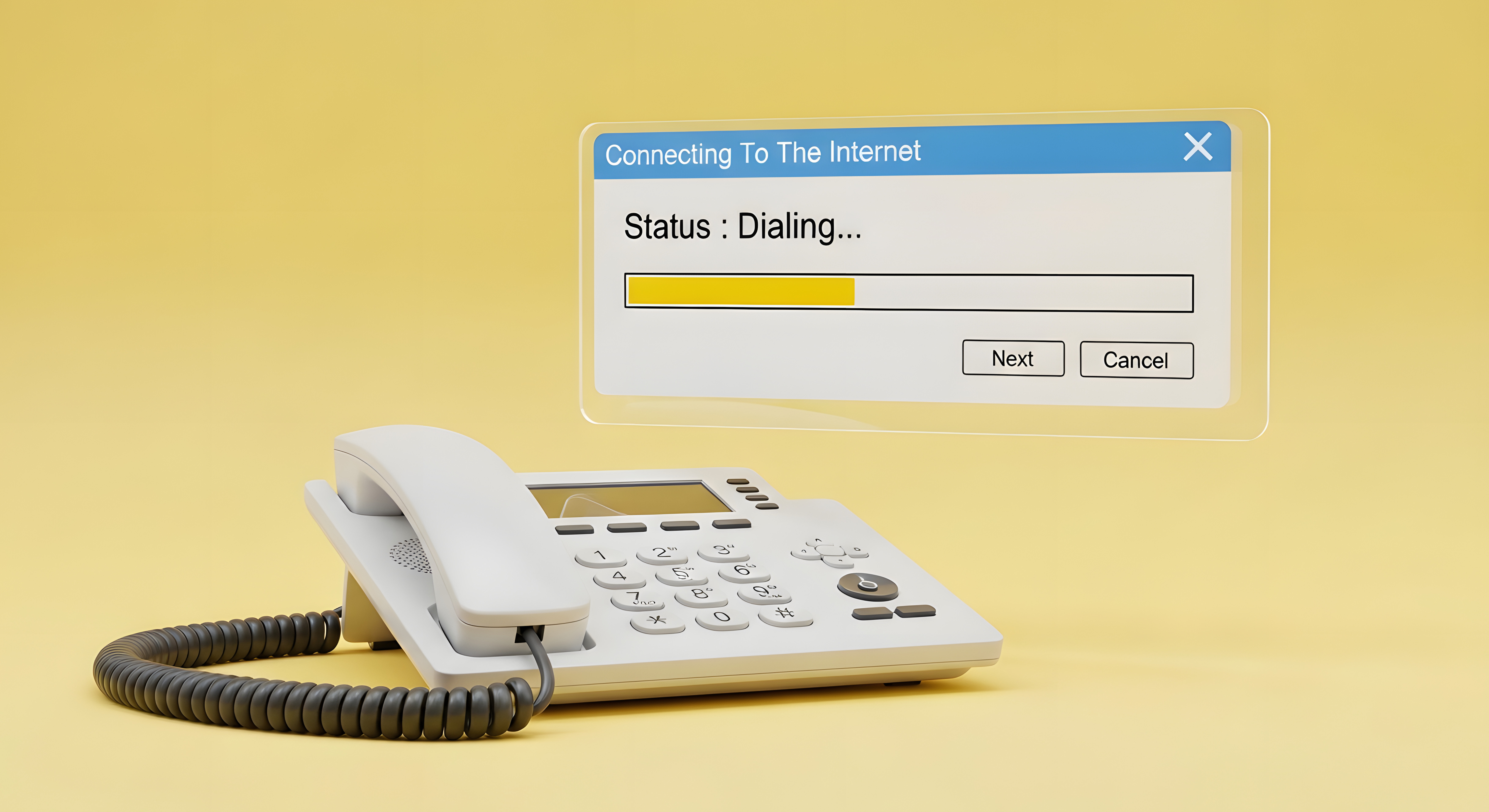
Do you remember the era of dial-up internet?
If you do, you’ll likely know that before modern broadband, connecting to the internet was an unlike anything you’ve experienced before. Every time you wanted to go online, you had to manually switch it on and then a familiar grey box would appear with some very basic graphics and the option to connect. You’d then wait for the dial-up and sit and listen to a whining, screeching noise until… minutes later you’d (eventually!) be connected.
Once online, things weren’t exactly fast either. Simple tasks like shopping, browsing or sending emails needed some serious patience. While it might be a fun memory for some of us, you’d be hard pressed to find anyone who’d swap today’s fast, reliable broadband for the dial-up connections of yesterday!
What is dial-up internet?
So, what actually was dial-up internet and how did it work?
Dial-up was a way of getting onto the internet using a modem that connects through a phone line. To go online, you needed an active telephone line that wasn’t being used at that exact moment in time.
That famous screeching noise was, in fact, the sound of your modem calling your Internet Service Provider's modem down the line. Once the call went through, you could then browse the internet, send emails, talk in chatrooms or download files, albeit very slowly compared to today’s standards.
What were the limitations of dial-up?

Looking back now, dial-up was incredibly limited compared to the broadband we have today.
Unlike today’s fixed-price broadband packages – the charges for using the internet were added to your phone bill by the minute (like making calls were) and spending several hours online could be pretty costly!
You also couldn’t make calls and use the internet at the same time. If someone picked up the phone while you were online, it would immediately cut your internet connection off. A bit like turning on the tap while someone’s in the shower. No doubt, it caused a few family arguments back in the day.
Dial-up’s speeds also maxed out at 56Kbps. Activities we now take for granted like online gaming, watching Netflix, or FaceTiming friends would be practically impossible on a basic dial-up connection.
The legacy of dial-up
Still, even with its limitations, many households’ first online adventures were facilitated by dial-up connection – whether that was using AOL or MSN chat, browsing Yahoo or Ask Jeeves. This is where the internet truly began for so many of us.
Some of our biggest online services, like Amazon and eBay, even started in this era. If it wasn’t for dial-up, we wouldn’t be where we are today.
When did dial-up internet end?
Dial-up’s popularity slowly phased out as faster, more reliable broadband connections steadily took over.
Dial-up has been effectively obsolete for quite some time – its position as the top connection declined around 2009 when over 50% of UK households had shifted to broadband. Even the older landline telephone lines that dial-up used are expected to be completely turned off across the UK around January 2027 as part of a move to newer mobile and digital VoIP technologies.
Since it first launched in the UK in 2000, broadband connection has been constantly evolving – from ADSL to part fibre and now to the new gold standard of full fibre broadband. And it’s truly exciting to think just what will be possible tomorrow as the speed and quality of the connections available to us continue to evolve!
What other internet options are available today?
The main connections on the market today are:
ADSL (Standard broadband): This runs over old copper telephones lines, is slower and less reliable than newer connections, and will soon be completely obsolete after the PSTN switch-off.
Part Fibre (or ‘Fibre to the Cabinet’ aka FTTC): This uses fibre optic from the exchange to the street cabinet, then copper into your home.
Full Fibre (or ‘Fibre to the Premises’ aka FTTP): This offers dedicated full fibre for the whole journey to your home – making high-quality, ultra-fast gigabit internet a possibility for today’s consumers.
Faced with these options, your best bet today is getting a full fibre connection.
The speeds of gigabit-capable, ultra-fast, and reliable full fibre would have been unimaginable back in the dial-up era.
Whether you’re looking to stream in 4K, gaming online, working from home or using smart home technology – or even all of these at once, full fibre can handle the needs of most modern households.
Why every home deserves the latest connection
Full fibre is what makes all this possible. It’s a connection you can invest in knowing that as your needs or the current technology changes, it’ll be fit to handle whatever’s next.
For this reason, LightSpeed believes everyone should be able to have access to quality full fibre to get the best possible performance from their internet. You can upgrade your home today by exploring all our full fibre options on our packages page here.
No more buffering. No more lag. Just pure, uninterrupted speed.
Switch to LightSpeed full fibre broadband today