
What is broadband?

The very first home broadband connection in the UK was installed in 2000 and marked a major step forward from old-school dial-up internet, which required you to manually connect each time you wanted to go online.
By the end of the 2000s, broadband had become the norm in most UK households. Today, 98.5% of UK homes have access to superfast broadband.
Broadband is now a part of most of our everyday lives – but what really is it? And where did it come from?
Broadband explained
Put simply, broadband is a term used to describe fast access to an internet connection that can handle large amounts of data being sent to multiple devices at the same time.
Instead of “waiting to dial up” like older internet connections, broadband means your internet is ready to use whenever you are. It’s what most of us rely on at home to do everyday things like watch TV, join video calls, browse websites, use social media, and download apps or files without delay.
The difference between broadband, internet and Wi-Fi
It’s easy to use the words broadband, internet and Wi-Fi interchangeably – most people do. But they actually mean slightly different things, and once you separate them out, it becomes much clearer how your connection at home really works.
Broadband
Broadband is the physical internet connection that comes into your home from your provider. It’s what delivers the internet to your property at high speed, whether that’s through fibre, cable or another network. Think of it as the infrastructure that makes everything else possible.
Internet
The internet is the global network of information and services that you access through your broadband connection. It’s the websites you visit, the apps you use, the videos you watch, and the data you send and receive every day.
Wi-Fi
Wi-Fi is the wireless technology that connects your devices to your broadband. It lets your phone, laptop or tablet access the internet without needing to be plugged in by cable, sending the broadband connection around your home wirelessly.
Put simply, broadband is the connection, the internet is what you use, and Wi-Fi is how you get connected without wires.
What types of broadband are there?
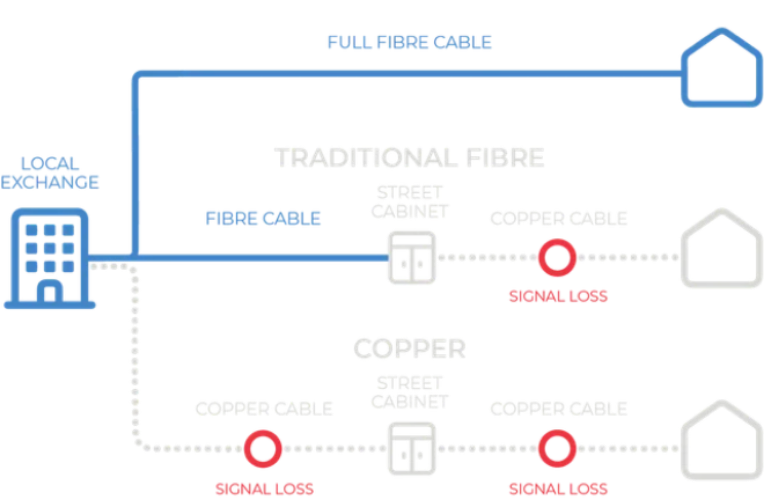
Broadband has changed a lot over the years. The names can sound technical, but the differences are fairly straightforward. It mostly comes down to how the connection reaches your home and how much of it uses newer fibre technology.
1. ADSL (Asymmetric Digital Subscriber Line) + ADSL2 broadband
ADSL was the first type of broadband widely used in UK homes.
It runs through the same copper phone lines as traditional landlines that have been used since 1876. While it was a big step up from dial-up at the time, it’s now one of the slowest options available.
2. Fibre to the Cabinet (FTTC)
FTTC is often referred to as standard or traditional fibre broadband.
It uses fibre optic cables to bring the connection to a street cabinet, then switches to copper cables for the final stretch into the home.
This makes it faster than ADSL, but speeds can still vary, particularly for properties further away from the cabinet.
3. Fibre to the Premises (FTTP) or Full Fibre:
Today’s gold standard for high-quality, fast internet connection. Full fibre is a dedicated fibre-only connection, that goes straight from your provider into your home – no sharing and no copper getting in your way.
4. Satellite broadband:
This delivers internet from space via a satellite dish on your premises. It’s often used in rural areas, where this is the only quality option, if full fibre isn’t available. But speeds are limited to 500Mbps, and it can be much more expensive.
5. Mobile broadband:
Mobile broadband uses the mobile network to deliver broadband instead. At the moment, it’s mainly used as an alternative to full fibre or satellite – especially if you can still get quality 4G or 5G signal. Speeds usually go up to around 300Mbps, so basic online tasks are fine – but you’ll need a special Mi-Fi router to get connected.
How fast can broadband go?
Broadband speeds have improved dramatically over the years. Back in 2000, the first broadband speed that came on the scene was 512Kbps. For perspective, that’s over 1000 times slower than today’s Gigabit speeds. We’ve come a long way since then!
Now, full fibre can deliver Gigabit and above speeds to most UK households. This opens the door for smart homes where many smart gadgets and devices are simultaneously streaming, downloading and uploading, without anything slowing down.
In short, modern Gigabit broadband handles it all with ease – so there’s really no more worrying about who’s hogging the connection!
Do I need business or residential broadband?
When you’re shopping for broadband, you might hit a fork in the road when it comes to choosing between residential and business packages. Broadly speaking, business broadband typically offers:
different pricing
higher bandwidth
leased line connections and static IPs
security features
dedicated, business-specialist support
But it’s also worth knowing, that in many providers’ terms and conditions, residential customers can’t buy business packages. And equally, business premises can’t buy residential broadband – no matter what size their operations are!
What about LightSpeed Broadband?
At LightSpeed, we focus on delivering high-quality full fibre broadband with speeds that go up to the soaring 5Gbps. It’s available for both business and residential customers to keep your life running, smoothly and efficiently, whatever your needs.
We even connect many areas with Gigabit broadband that other leading providers overlook – and our network and community is still growing all the time.
If you’re considering an upgrade or just want to learn more, it’s worth exploring what we can offer – so please feel free to get in touch.
No more buffering. No more lag. Just pure, uninterrupted speed.
Switch to LightSpeed full fibre broadband today